a better kind of breathing for the ones who want “more”
My first word was “more,” and while it always comes alongside a giggle when I share it at parties, I also know it was a premonition.
That I’d spent most of my young life over-eating, over-sleeping, over-drinking, and then over-correcting it all, too. Starving, striving, abstinence.
I was born with a binge-restrict pattern that knows no bounds.
“More” was a signal that I couldn’t trust myself in the middle. That I couldn’t trust myself to call it at enough.
When I latched onto the concept of Leisure Ethic it wasn’t just a cute way of saying “have fun.”
It was a means to escape the shame of my “more,” reclaiming it as something I didn’t have to deny, but also wouldn’t end up drowning in.
The thing with all that pendulum swinging is I never really cared for the “less” part.
I didn’t want to stop wanting. To say “no thank you.” Be demure. Be deprived.
But the “less” was well-practiced. Calm, quiet, measured. And because I hadn’t been allowing my “more” to show every day, it would build up to be unleashed on the weekends and completely take hold.
Leisure Ethic began as a movement, just for me, to let my “more” be heard on the weekdays, too.
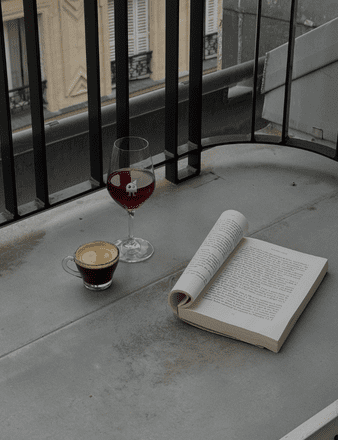
The version of me that craves the glass of wine when the sun hits just right in the afternoon. The version of me that longs to get lost in an idea even if means working for 12 hours straight.
I stopped saving the extreme for when no one was watching, and started trusting it out in the open.
And of course, once it met the air, it began to dilute.
With a cycle that could repeat daily, there was never the need for a drastic detox.
Bites of freedom between sips of focus.
Flirting with chaos stopped spiralling into a loss of control.
Leisure Ethic kept the “more” manageable.
In, out.
In, out.
A better kind of breathing for those of us who want.
I’ve spent the last year practicing Leisure Ethic. Basking in it’s light and understanding it’s shadow. Finding it’s edges. Examining them. Choosing different. Determining when it serves me and when it sucks me back into shame. Familiarizing myself with it’s commandments, making note when a new becomes clear.
Through this process I’ve created my compass, a code of conduct for a life enjoyed.
“More,” but with morals.
Because contrary to what you might guess, the opposite of Leisure Ethic isn’t work ethic… It’s hedonism.
Leisure Ethic is the pursuit of pleasure, yes — but in this case, there’s principle.
10 of them, to be exact.
THE PRINCIPLES OF LEISURE ETHIC
001 / MAKE IT PLEASURE
I used to live in the binary of “this fucking sucks” or “this is fun.” Make It Pleasure is the practice of letting it be both — taking the have to and turning it into a want to, by adding whatever fixins will make it feel good. Or at least, better. Answer emails from a chic wine bar. Take a Zoom call from the couch. Get your steps in en route to your favourite book store. Hedonism seeks pleasure as an avoidance of pain, but here, we learn to let them coexist.
002 / FOCUS IS FREEDOM
It’s easy to adopt “freedom” as a complete rejection of ALL rules, but true fulfillment can only be found when we create our own. Containers within which we can progress, untethered, but channeled towards a goal so that we don’t just exist, unmoving. Freedom, in the absence of focus, is floating — which sounds a bit too much like stagnancy, for me. We’re whimsy, not directionless!
003 / MARKETING AS CREATIVE PRACTICE
I once scribbled down the statement, “we all have to market our businesses, so why are we settling for hating it?!” and this principle is pretty much an answer to that. This isn’t just about a mindset, nor is it an ask to commodify your creativity for the sake of self-promotion. Marketing as Creative Practice is about moulding your marketing to fit as closely with the creative acts you enjoy, as possible. If you’re a writer, write. If you’re a photographer, take photos. If cooking is your outlet, weave it in.
004 / MONEY CAN’T BUY TIME
Wildly controversial! The business bros are quaking! But the deal with this one is that I see a lot of entrepreneurs ~waiting~ for permission, in the form of a paycheque, to claim the amount of free time they desire. But it doesn’t work. Sure, they make the money — but they also keep having no time. Eventually, the call has to be made: are you going to choose the time or not? More money usually makes that choice harder, because then it feels like you might have to give some cash up to get that time back (I don’t agree with this, but I get it). The Leisure Ethic of it all is to start claiming the time now, so that the money you make is in relationships to the life you want to lead, fitting AROUND IT, from the very beginning.
005 / LITTLE TREAT THEORY
This plays out really cutesy but it’s kind of deep, too. Back in September, I started tracking my spending habits METICULOUSLY, after flying pretty looooose in that regard for the last few years. I thought for sure that I’d end up feeling deprived, but the deprivation evaporated as soon as permission entered the chat. Once I actually knew how much money I had to spend each week, I no longer had to “be good” Monday-Friday just to cushion the fact that I would be balling out on the weekends. I started buying myself a little treat every day or two — a coffee here, a piece from the thrift shop there — and seven months later, I’m spending less money than ever by buying things more often. Things that make me feel good daily, instead of a spending spree that was making me feel like shit, weekly.
006 / HARD CONVERSATIONS = EASY LIFE
The things that will make your life the most enjoyable, the most aligned, the most leisurely, if you will, are things that require decidedly un-fun conversations. Every leap that’s changed the landscape of my life has included an email I didn’t want to send, or a question that I didn’t want to ask. It will suck, but it will set you free.
007 / IT’S NOT THE THING, IT’S THE CIRCUMSTANCE
A distant cousin of “Make it Pleasure,” but the examination of why we dub things sucky vs. fun, in the first place. And usually it’s not really the thing — it’s the circumstance around the thing. For example, I used to think I hated being on Zoom calls. I would feel so anxious leading up to them, suffocated by the thought of being on them, and drained by the end of them. So, obviously, I thought calls sucked. As I started freeing up my schedule in other ways, though, I realized some things: Calls with long-time clients, I loved. Calls with groups, I loved. Calls in the late afternoon, I loved. Calls when there were no other calls on my calendar that day, I loved. “Calls” were never the problem — the kind of calls and the way I’d scheduled them was.
008 / BUILD YOUR LIFE LIKE A BUSINESS
I technically identify as the sole earner, because while my husband supports with some finance and admin, none of his actions are tied to the things that make our business money. It never feels that way, though. Because he’s the sole laundry-do-er, the sole talk-to-lawyers-to-get-us-work-visas-er, the sole makes-the-bed-every-day-er, the sole comforts-me-when-I’m-in-a-luteal-spiral-er, the sole not-letting-the-car-run-out-of-oil-er. You get the idea. I don’t identify as the one with the money-making job because there is no divide between what is work and what is life, here. It’s just a bunch of stuff that adds up to a whole I’m happy to be in. And this isn’t just a partnership thing — it’s a concept that helps us remember that we aren’t either “working to live” or “living to work” as if there’s one right answer. Living is work. Work is living.
009 / DON’T TIE YOUR INCOME TO SHIT YOU HATE
Simple, and yet… For years, I believed the lie that work is supposed to be difficult. That if we run our own businesses, we have to be willing to swallow the unsavoury bits. And so, I made that mistake. There were several unsavoury bits that I not only swallowed, but monetized. Eventually, I had my “oh my god I hate this business” moment and removed all that shit. You will, too. So do whatever you can to move forward, now, without it. Yes, there’s still going to be annoying stuff, but it can’t be the stuff your clients pay you for. The actions that bring in revenue — that result in a direct financial exchange — have to be the things you love.
010 / MAKE YOUR VICES KNOWN
I spent years searching for “proof” that I was allowed to drink martinis and have a successful business. Any time I would find an Instagram where someone with a professional presence was openly talking about being hungover, or posted a photo that unapologetically featured hard liquor, I saved it to a folder called “expansion.” But this isn’t just the plague of the party girls — I have worked with hundreds of clients who feel inordinate levels of shame around their reality TV consumption, their spending habits, how late they go to bed, how late they wake up, the fact they’d rather start their day with a smut novel than a pilates class. We are all being sold a singular version of success, and we are all begging for a different option because we don’t fully identify with it. Keeping your guilty pleasure under wraps is what keeps it guilty. As long as we perpetuate the former, we’re making ourselves, and our people, feel wrong.
What is leisure to me may not be leisure to you, but the Principles of Leisure Ethic will guide you to claim — and stand proudly — in whatever is.
Today, I see my “more” as a gift.
A desire for desiring.
A knowing what meant for.
A compass
“More,” is me.
“Less” was just who I thought I was supposed to be.
𐄂𐄂